
Add Custom Attributes to the Root Span with Tracing Module
You might want to add custom attributes to the root span of a transaction if:
-
You want to attach transaction-level fields, such as a client ID or conversation ID, to the primary span instead of a child span.
-
You want the attributes to be present on the root span regardless of how deeply nested the flow that sets them is.
For these scenarios, the Tracing module Add Root Span Attributes operation enables you to add key-value attributes to the current transaction’s root span.
This operation builds on Mule runtime’s OpenTelemetry tracing support. Before using it, see OpenTelemetry Support in Mule Runtime to understand traces and spans, and to configure trace export.
| This operation requires Mule runtime engine 4.13 or later. On earlier runtimes, it is a no-op. |
Configure the Add Root Span Attributes Operation
In the following Mule app example, you configure the Add Root Span Attributes operation in Anypoint Code Builder:
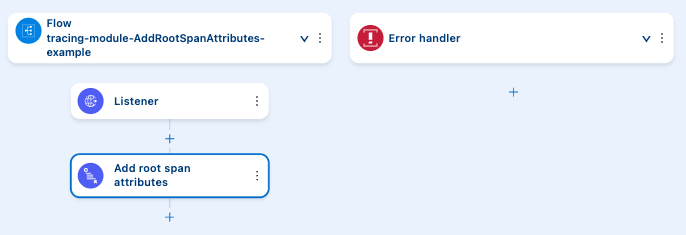
-
In the canvas UI, click the
 (Add component) icon, search for
 Listener, and select Listener from the HTTP results. -
On the General tab, set Path to
/test. -
Add an HTTP Listener configuration (
<http:listener-config>) that listens on port8081. See Add a Global Configuration. -
Click the
(Add component) icon after Listener, search for Tracing, and select Add Root Span Attributes. -
On the General tab, set Attributes to
#[{'clientId': attributes.queryParams.clientId}]: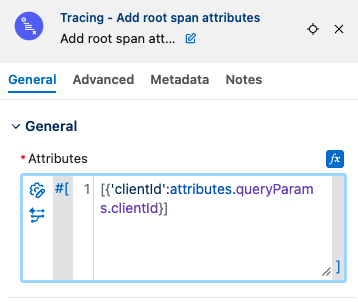
-
Run your application.
-
In a terminal, run
curl "localhost:8081/test?clientId=example-client".
The clientId attribute is added to the root span exported for this transaction when the transaction ends.
XML for Configuring Add Root Span Attributes
Paste this code into the configuration XML file of your integration project to quickly load the flow for this example into your Mule app:
<?xml version="1.0" encoding="UTF-8"?>

<mule xmlns:tracing="http://www.mulesoft.org/schema/mule/tracing"
	xmlns:http="http://www.mulesoft.org/schema/mule/http"
	xmlns="http://www.mulesoft.org/schema/mule/core" xmlns:doc="http://www.mulesoft.org/schema/mule/documentation" xmlns:xsi="http://www.w3.org/2001/XMLSchema-instance" xsi:schemaLocation="http://www.mulesoft.org/schema/mule/core http://www.mulesoft.org/schema/mule/core/current/mule.xsd
http://www.mulesoft.org/schema/mule/http http://www.mulesoft.org/schema/mule/http/current/mule-http.xsd
http://www.mulesoft.org/schema/mule/tracing http://www.mulesoft.org/schema/mule/tracing/current/mule-tracing.xsd">
	<http:listener-config name="HTTP_Listener_config" >
		<http:listener-connection host="0.0.0.0" port="8081" />
	</http:listener-config>
	<flow name="tracingmodule3Flow"  >
		<http:listener config-ref="HTTP_Listener_config" path="/test"/>
		<tracing:add-root-span-attributes>
			<tracing:attributes><![CDATA[#[{'clientId': attributes.queryParams.clientId}]]]></tracing:attributes>
		</tracing:add-root-span-attributes>
	</flow>
</mule>
Behavior and Limitations
The root span is exported when the transaction ends, so attributes added anywhere on the synchronous path of the flow are included in it. However, a span cannot be modified after it has already been exported, which leads to the following limitations:
-
Do not use this operation inside an
asyncscope. Theasyncscope’s span is a child of the flow (root) span, in the same local trace, so the root does not move to the async branch. The problem is timing: the main flow does not wait for theasyncblock to finish, so the flow (root) span can be exported before or after theasyncblock runs. Whether the attribute makes it onto the exported root span therefore depends on unpredictable thread scheduling:mule:flow <-- ROOT SPAN (root span attributes land here) ├── mule:set-variable ├── mule:async <-- child span; runs on its own thread, same trace │ └── tracing:add-root-span-attributes <-- may run after the root span is already exported └── mule:set-variableBecause the outcome is not deterministic, set root span attributes from the flow’s synchronous path instead of from inside an
asyncscope. -
A
flow-refshares the caller’s trace. A referenced flow runs within the same local trace as its caller, so attributes that this operation sets inside a referenced flow land on the caller’s root span, not on a separate root for the referenced flow. -
Distributed traces are enriched locally. When a request arrives with an inbound distributed trace context from a remote caller, this operation adds the attributes to this application’s own local root span, which is a child of the remote span. The attributes are never propagated back to the upstream caller’s span.
-
Root span attributes survive sampling and low tracing levels. Because the attributes are added to the root span rather than to a child span, they remain in the exported trace even when child spans are dropped by sampling, or when
mule.openTelemetry.tracer.levelis set toOVERVIEW, which exports only the root span.